


Last Updated: November 14, 2026
Quick Summary
A premium barrel smoker is worth it for backyard chefs when its build, heat control, and capacity hold up over years of cooking. Carnivore U.S.A builds its barrel smokers from food-grade 304 stainless steel and backs them with a lifetime rust warranty, so the smarter question is cost per cook, per year, and per guest fed.
- A barrel smoker cooks low and slow over indirect heat, while a regular grill cooks hot and fast over direct heat.
- A barrel produces roughly 90% less smoke than an open grill, so neighbors stay friendly.
- The Medium at $303.00 feeds up to 12 and is the recommendation for most backyard chefs.
- Plan on roughly half a pound of finished meat per guest for a mixed menu.
- Adjust one vent at a time and give the barrel five to ten minutes to respond.
Table of Contents
- What Makes a Barrel Smoker Worth the Investment
- Barrel Smoker vs Regular Grill: What Changes in Your Backyard
- Carnivore Barrel Smoker Lineup: Prices and Specs Compared
- Barrel Smoker Cooking Capacity: Matching the Barrel to Your Guest List
- Barrel Smoker Temperature Control and the Real Learning Curve
- How to Use a Barrel Smoker: Light It, Hang It, Walk Away
- Build Quality, Warranty, and the Cost of Ownership
- Accessories That Extend What the Barrel Can Do
- Which Carnivore Barrel Smoker Fits Your Backyard
- Frequently Asked Questions
What Makes a Barrel Smoker Worth the Investment
A premium barrel smoker for backyard chefs is worth it when the build, the heat control, and the capacity all hold up over years of cooking, not one season. Carnivore U.S.A builds its barrel smokers from food-grade 304 stainless steel and backs them with a lifetime rust warranty. Most buyers compare sticker prices and stop there. The smarter question is what the smoker costs you per cook, per year, and per guest fed.
A barrel smoker is a vertical charcoal cooker that hangs meat on hooks above a charcoal basket, using airflow through intake and exhaust vents to hold low-and-slow temperatures for hours. That design is the whole argument for buying one.
Below, we break down what separates a premium barrel from a disposable one, compare it against the grill you already own, and size the Carnivore lineup to your actual guest list. But first, here's what most guides get wrong: they treat capacity as a number on a box rather than a workflow you'll live with every weekend.
Barrel Smoker vs Regular Grill: What Changes in Your Backyard
A regular grill cooks hot and fast over direct heat. A barrel smoker cooks low and slow over indirect heat, and that single difference changes the food, the fuel bill, and how you spend your afternoon.
On a gas or kettle grill, you stand at the grates flipping, moving, and watching. Chicken breasts go on, come off in twenty minutes, and the cook never leaves the patio. A barrel smoker inverts that. You light the charcoal basket, hang the meat on hooks, set the vents, and walk away. The barrel's convection system circulates heat evenly around the food, so a whole chicken or a pork shoulder cooks without turning.
The trade-offs are real, and worth naming:
- Time: A grill is a 20-minute commitment. A barrel smoker is a 4-to-12-hour one, most of it unattended.
- Smoke: A barrel produces roughly 90% less smoke than an open grill, so neighbors stay friendly.
- Flavor: Charcoal and wood in a closed barrel build bark and smoke flavor a gas grill cannot match.
- Fuel: A barrel smoker sips charcoal compared with a grill running wide open for hours.
- Capacity: Hooks and vertical space let a barrel hold far more meat than a same-footprint grill.
If you want dinner in half an hour, keep the grill. If you want a whole feast that cooks while you do something else, the barrel wins.
Carnivore Barrel Smoker Lineup: Prices and Specs Compared
Four models cover the range from a couple's patio to a catering job. Here is how they stack up.
| Model | Price | Capacity | Feeds | Height x Diameter |
|---|---|---|---|---|
| Jumbo | $580.00 | 65 lbs | Up to 40 | 37.4 in x 21.7 in |
| Large | $409.00 | 45 lbs | Up to 25 | 30.7 in x 17.7 in |
| Medium | $303.00 | 25 lbs | Up to 12 | 25.6 in x 15.7 in |
| Mini | $223.00 | 12 lbs | Up to 5 | 21.7 in x 12.7 in |
Capacity
Jumbo: 65 lbs for Up to 40 People
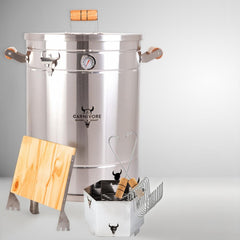
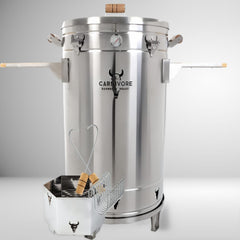
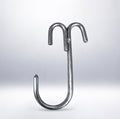
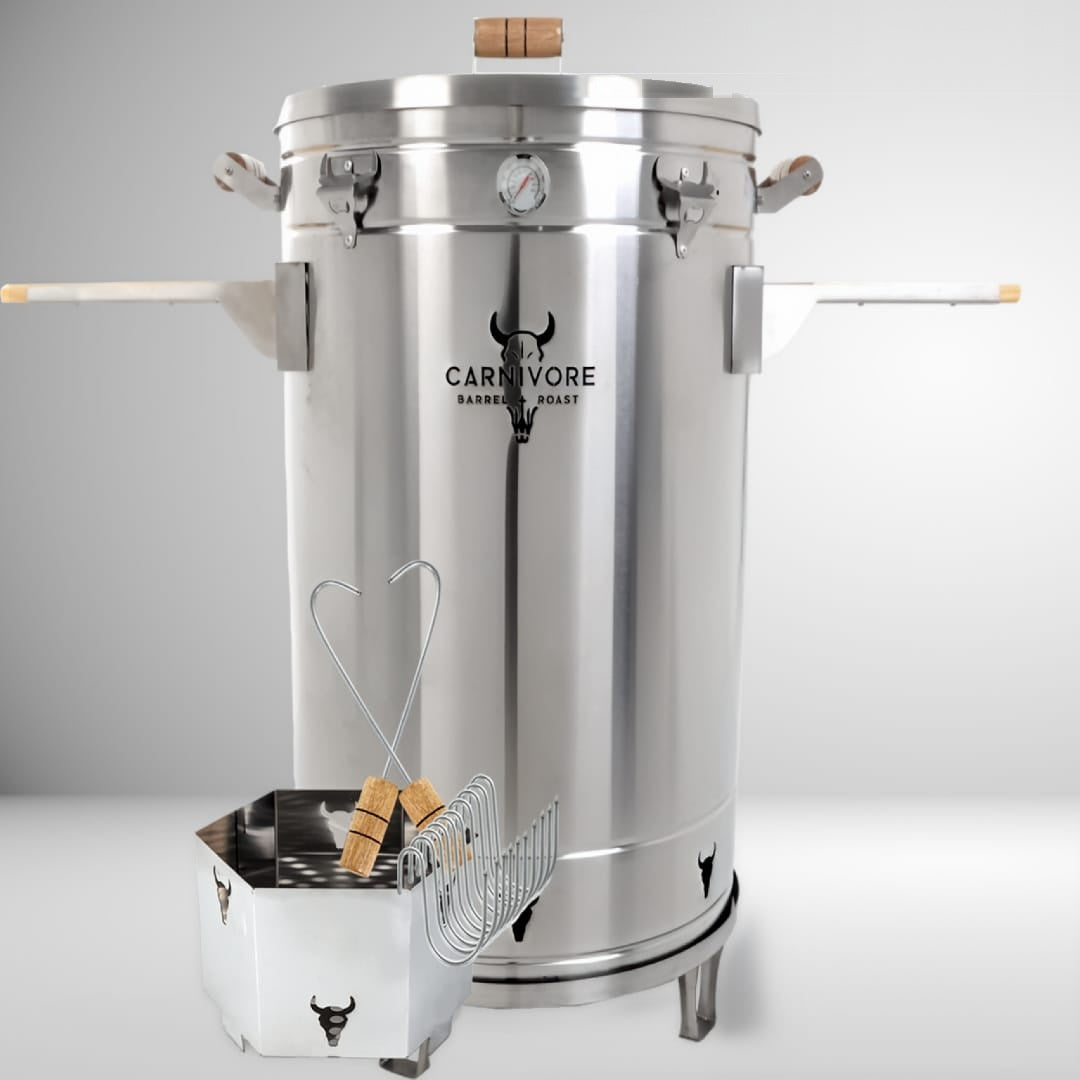
The Jumbo is the largest barrel in the line and the one to buy if you host events, cater, or cook for a crowd every weekend. It holds up to 65 lbs, roughly 12 to 13 whole chickens, and ships with the fullest accessory package: two wood side tables, 15 meat hooks, a sausage rack, a folding grill grate, a whole-chicken accessory, and a wood bear claw. See the full Jumbo specs and details before you commit.
Large: 45 lbs for Up to 25 People
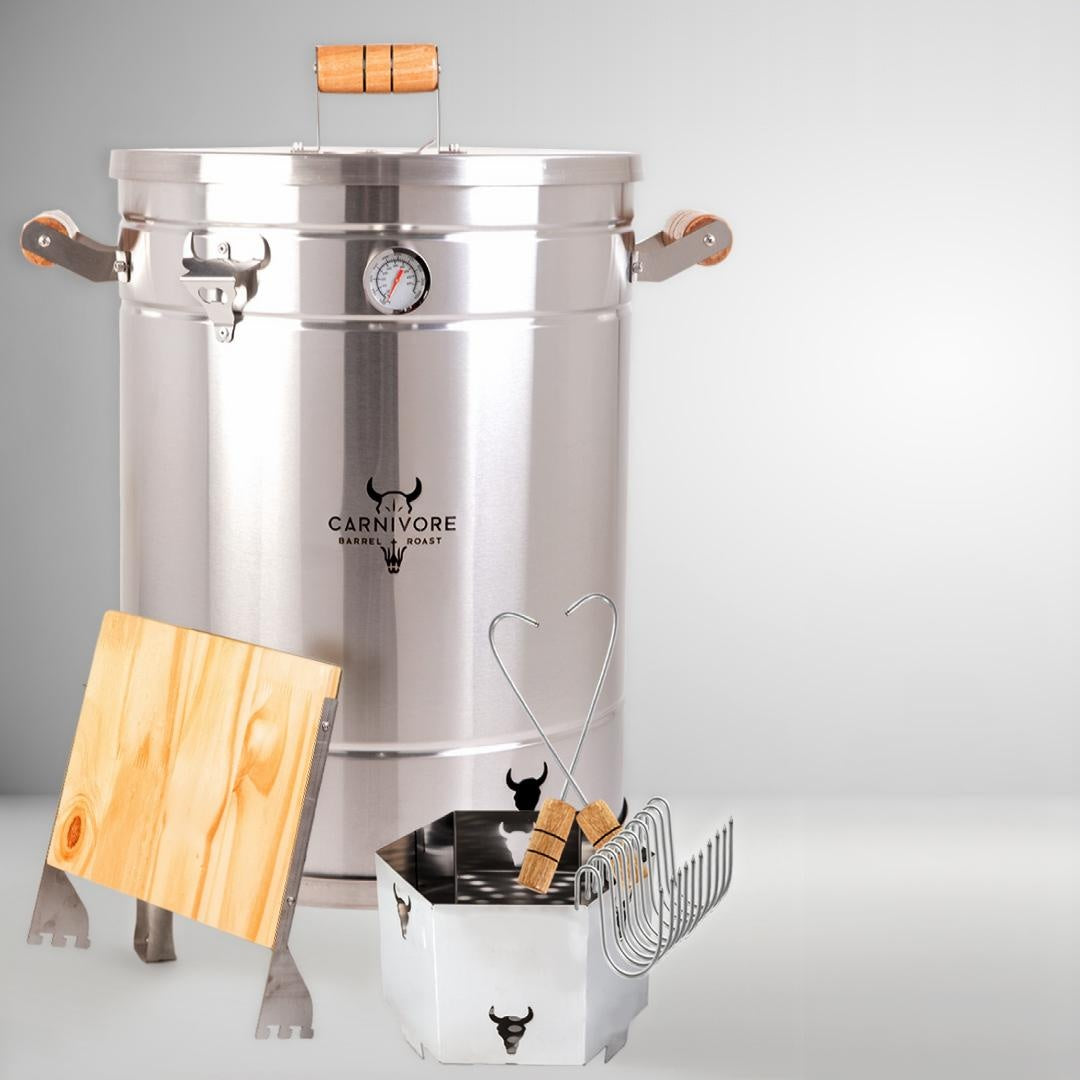
The Large suits backyard cooks who feed a big group. It holds up to 45 lbs, about 8 whole chickens, and includes a wood side table, 10 hooks, a precision thermometer, and the heat circulation system. Compare the Large model's specs against the Jumbo if you're torn between the two.
Medium: 25 lbs for Up to 12 People
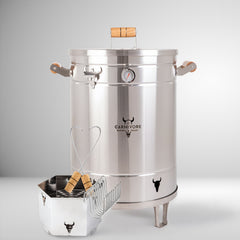
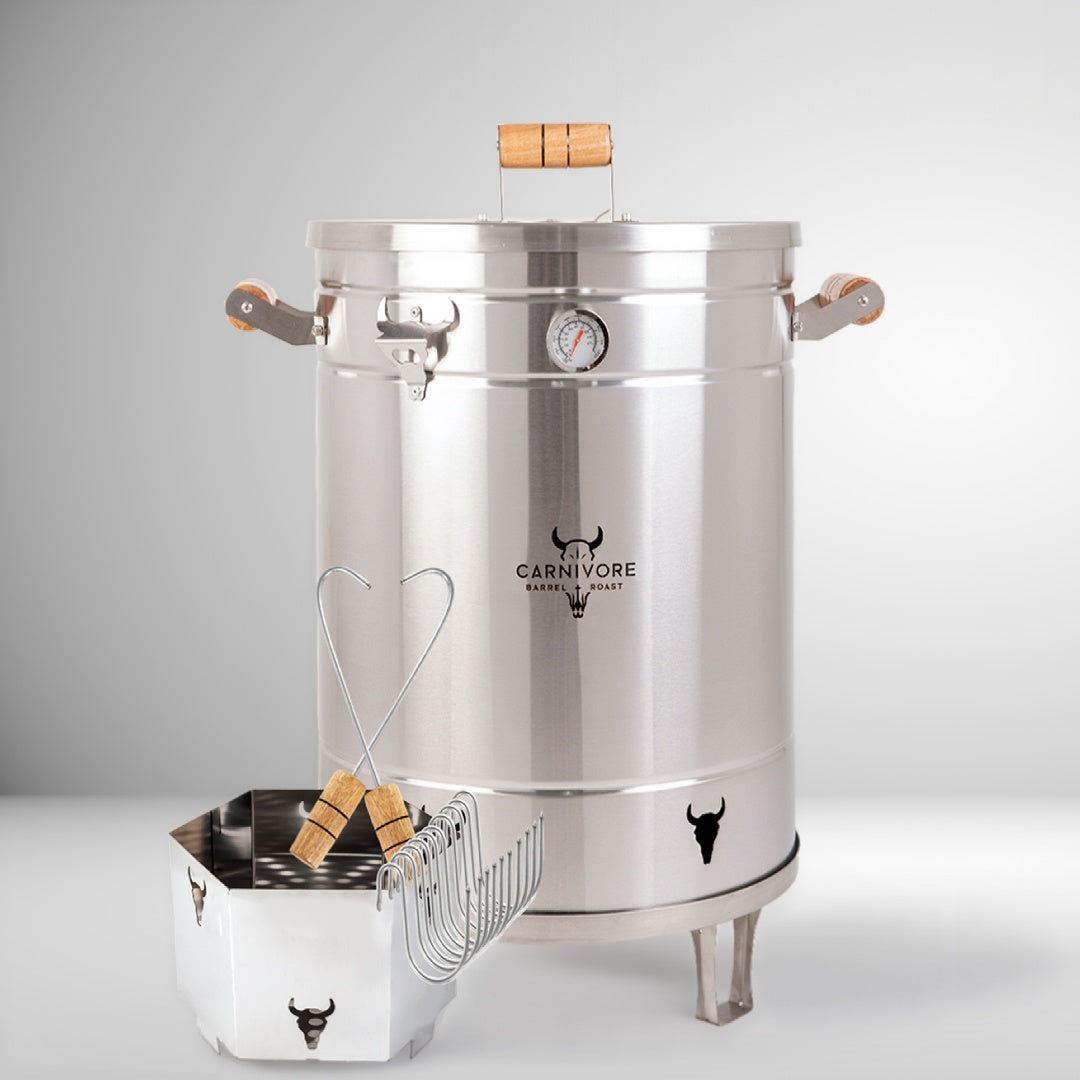
The Medium is the family favorite. It holds up to 25 lbs, or 4 whole chickens, and works with wood charcoal or briquettes. Check the Medium model's details if your guest list tops out around a dozen.
Mini: 12 lbs for Up to 5 People
The Mini suits couples, small families, apartments, and first-time smoker buyers. It holds up to 12 lbs, one whole chicken, and uses very little charcoal. See whether the Mini fits your space before sizing up.
Barrel Smoker Cooking Capacity: Matching the Barrel to Your Guest List
Cooking capacity is the spec buyers misjudge most. The number on the box tells you pounds of meat, not how many people leave full, and the two are not the same.
A practical rule: plan on roughly half a pound of finished meat per guest for a mixed menu, more if you're serving heavy cuts like brisket or pork shoulder. A 25-lb cook feeds a dozen comfortably with sides. A 65-lb cook handles a 40-person event.
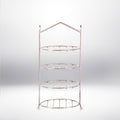
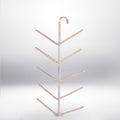
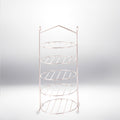
The barrel's vertical design is the advantage here. Hanging hooks let you stack whole chickens, ribs, and sausage at different heights, using space a flat grate wastes. The 7-Level Multipurpose Accessory takes that further, letting you suspend corn, sausage, and chicken pieces on separate racks at once for $43.00.
What most guides miss is the workflow angle. A barrel loaded to full capacity takes longer to come up to temperature and needs more charcoal, so cooking 12 lbs in a 65-lb barrel is inefficient. Match the barrel to your typical cook, not your biggest one.
Barrel Smoker Temperature Control and the Real Learning Curve
Temperature control on a barrel smoker comes down to adjusting airflow through the vents. Open them to raise heat, close them to lower it. The real question backyard chefs ask is how much attention the barrel needs and how reliably they can repeat a cook.
A barrel smoker manages heat through its vents: the intake controls how much oxygen reaches the fire, and the exhaust controls how much heat and smoke leave the barrel.
The learning curve is real, and the first few cooks help you learn how your barrel responds. Your first cook will run hot or cool while you learn how your barrel responds. The thermometer gives you a read without opening the barrel, which matters because every peek dumps heat and adds time.
A few habits speed up the curve:
- Fill the charcoal basket consistently so each cook behaves the same. A half-full basket burns differently than a full one.
- Adjust one vent at a time and wait before changing anything else. Give the barrel five to ten minutes to respond.
- Keep the exhaust open and control heat with the intake. Closing the exhaust chokes the fire and creates stale smoke.
- Use the same charcoal every cook until you know the barrel. Switching between briquettes and lump changes the burn.
- Start with fewer lit coals than you think you need. It is easier to raise temperature than to bring it down.
Weather is the variable most guides skip. A barrel smoker in direct sun on a 90°F day will run hotter than the same barrel in shade, and a cold wind pulls heat through the barrel faster than still air. A windbreak or a sheltered patio corner can help keep the barrel's temperature steadier.
If you're worried about babysitting, our guide to smoking meat without constant attention walks through the hands-off method in detail. The short version: a barrel that holds temperature well lets you set it and leave it, and the habits above are how you get there.
How to Use a Barrel Smoker: Light It, Hang It, Walk Away
Using a barrel smoker takes three steps: light the charcoal basket, hang the seasoned meat on hooks, and set the vents to hold your target temperature. The barrel does the rest.
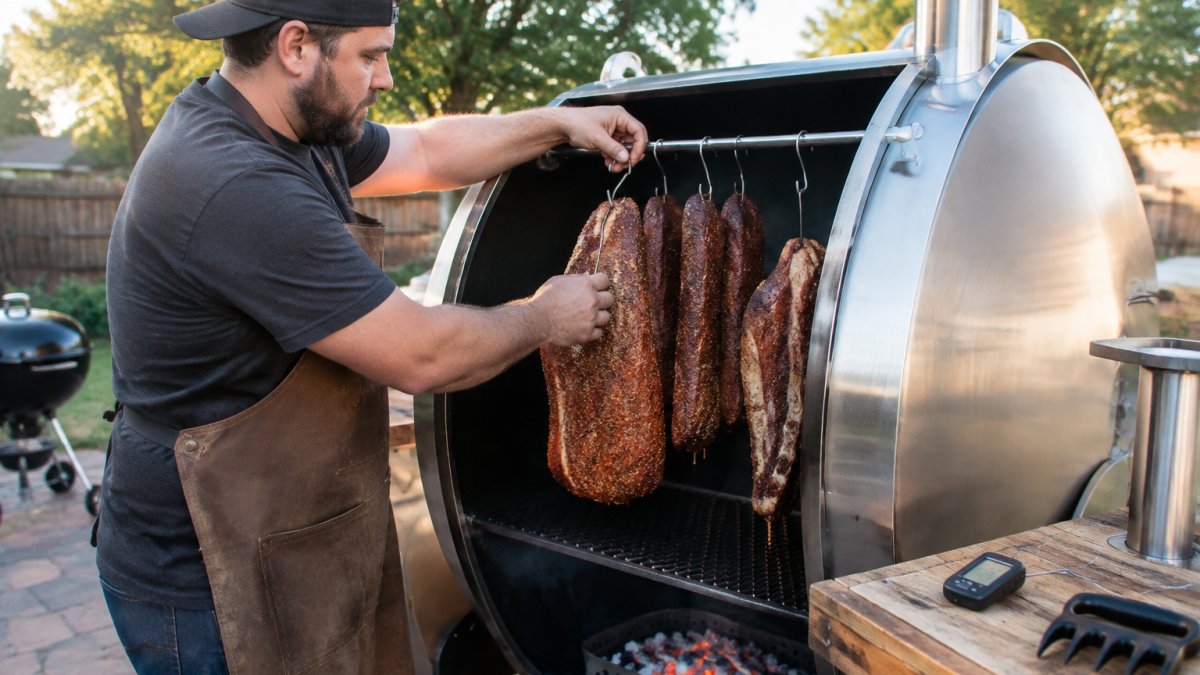
Here's the sequence we recommend:
- Light the basket. Fill the charcoal basket, light a chimney of coals, and pour them over the unlit charcoal for a long, steady burn.
- Set the vents. Open the intake and exhaust wide until the barrel reaches temperature, then close the intake down to hold it.
- Hang the meat. Hook seasoned cuts and hang them so they don't touch each other or the barrel wall.
- Walk away. Check the thermometer periodically, not every twenty minutes. Opening the lid costs you heat.
- Pull and rest. Remove the meat when it hits your target temp and let it rest before slicing.
The barrel is designed so you can light it, hang your food, and walk away.
Build Quality, Warranty, and the Cost of Ownership
Build quality is where a premium barrel smoker earns its price, and it's the spec you can't see in a photo. Ours are made from food-grade 304 stainless steel and handmade in Colombia. But "stainless steel" is not a single thing, and the details are what separate a barrel that lasts five seasons from one that lasts twenty.
Steel quality is a meaningful factor when comparing barrel smokers, and 304 food-grade stainless steel is the material Carnivore uses.
The failure mode to watch for is coating breakdown. A coated steel barrel looks fine in year one and starts flaking by year three, usually at the firebox and the lid rim where heat and moisture concentrate. Once the coating fails, rust starts underneath and the barrel is on a replacement clock. Stainless steel doesn't have that failure mode, which is why the warranty question matters.
The warranty covers rust. A lifetime rust warranty is only as good as the company behind it, so check two things before you buy any premium barrel: whether the warranty covers the body and the firebox, and whether replacement parts are available for vents, thermometers, grates, and baskets. A barrel with a strong body but no parts support becomes a disposable item the first time a handle or grate wears out.
Ask any manufacturer whether replacement parts are available and for how long.
When comparing cost, consider how long a barrel will last, not only its purchase price.
Ask about steel thickness, coating or lack of it, warranty terms, and parts availability before you compare sticker prices.
Accessories That Extend What the Barrel Can Do
Accessories turn a barrel smoker from a one-trick cooker into a full outdoor kitchen. The hooks and folding grate that come standard already cover most cooks, but a few add-ons expand the menu.
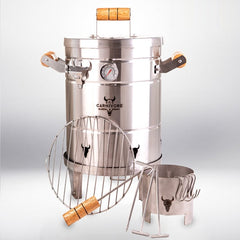
The 7-Level Multipurpose Accessory is the standout. It lets you arrange different foods on separate racks and cook them suspended inside the barrel, so you can run sausage, corn, and chicken pieces at once. It's made of stainless steel, reusable, and easy to clean, and it comes in 5- and 7-level versions to match your barrel's interior height.
Other accessories worth knowing:
- Wood side tables give you landing space for tongs, thermometers, and trays.
- The bear claw shreds pork shoulder in minutes.
- The sausage rack keeps links from falling through the grate.
- The ash tray makes cleanup a lift-and-dump job.
A common mistake is buying accessories before you know your cooking style. Cook a few rounds first, then add what you actually reach for.
Which Carnivore Barrel Smoker Fits Your Backyard
The right barrel comes down to your guest list and your patio. Here's our honest read on each model.
The Mini at $223.00 is the pick for couples, small families, and anyone with limited space. It's not overkill for a household of four, and it uses very little charcoal.
The Medium at $303.00 is our recommendation for most backyard chefs. It feeds up to 12, handles a mix of cuts, and fits a normal patio without dominating it.
The Large at $409.00 suits the host who regularly feeds a crowd of 20-plus and wants a side table built in.
The Jumbo at $580.00 is for caterers, event cooks, and anyone feeding 40. If you host big gatherings, the extra capacity and accessory package pay for themselves.
Still deciding? A barrel smoker for backyard chefs should match the cook you actually are, not the one you imagine. Start with your typical weekend, size up one model, and you'll have room to grow without buying twice.
The real test of a premium barrel smoker isn't the first cook, it's the fifth season. Cheap barrels rust, warp, and get replaced. A 304 stainless barrel with a lifetime rust warranty, free U.S. shipping, and delivery in 2 to 6 business days is built to be the last smoker you buy. Carnivore U.S.A gives you food-grade 304 stainless steel construction, capacity for 5 to 40 people, and a light-it-and-walk-away design that turns a whole feast into an afternoon off. Get started with Carnivore U.S.A and cook your next gathering over real fire.
Frequently Asked Questions
What should you look for in a premium barrel smoker?
Focus on four things: the steel, the capacity, the airflow design, and the warranty. Food-grade 304 stainless steel resists rust and avoids coatings that chip into food. Capacity should match your largest regular gathering, not your average one. A barrel with intake and exhaust vents plus a convection design holds steadier temperatures. Carnivore builds all four models from 304 stainless and backs them with that warranty.
How does a barrel smoker compare with a regular grill?
A regular grill cooks hot and fast over direct heat, so you stand at the grate flipping and watching. A barrel smoker uses indirect heat and air circulation to cook low and slow, which produces smoke flavor and bark. The barrel also holds far more food: the Jumbo handles 65 lbs, roughly 12 to 13 whole chickens, For large gatherings, the barrel does the work while you host.
How many people can a barrel smoker cook for?
It depends on the model. The Carnivore Mini handles up to 5 people with 12 lbs of meat capacity, the Medium covers up to 12 people with 25 lbs, the Large feeds up to 25 with 45 lbs, and the Jumbo serves up to 40 with 65 lbs. Pick the size one step above your typical party so you have headroom for holidays and bigger cuts like whole legs or multiple chickens at once.
How do you control temperature in a barrel smoker?
Temperature control in a barrel smoker comes down to airflow and fuel. Start with a chimney of lit charcoal in the basket, then adjust the intake vent at the bottom to feed oxygen and the exhaust vent at the top to release heat and smoke. Small vent adjustments help settle the barrel into a steady range.
Are barrel smokers good for beginners?
Yes, the hanging-style design keeps the process simple. Light a charcoal basket, hang your meat on hooks, set the vents, and let the convection system do the work. The main skill to learn is vent adjustment, Starting with a smaller model like the Medium or Mini keeps the fuel load manageable while you learn how your barrel responds.
